


Origin of Christmas and its Traditions-1
- Sivaraj Kumar
- Dec 21, 2019
- 5 min read
Updated: Dec 22, 2019
Jingle bells, jingle bells,
Jingle all the way;
Oh! what fun it is to ride
In a one-horse open sleigh
Christmas is on its way! I have started seeing people counting days in WA status.
Children are waiting for beautiful presents from Santa. And adults are waiting to celebrate the birth of Jesus Christ, whom they believe is their Lord/Saviour and Son of God.
People believe in all kinds of stuff. During Jesus's period, we had many people who claimed to be the Son of God. Take Augustus for example....

A coin from 50 BCE saying "Son of God" with Augustus's image
I am not going to talk about whether Jesus is the true "Son of God" here. This is about the Origin of Christmas and its Traditions. (This is Part 1. I will post Part 2 very soon.)
ORIGIN OF CHRISTMAS
I have asked many Christians why they celebrate Christmas on Dec 25. It's obvious, right?
Christ+Mass = "Jesus Christ"+"Mass/Church Service"
ORIGIN OF XMAS
Chi (or X) is the first letter in the Greek word for Christ. In the early days of the Christian church, Christians used the letter X as a secret symbol to indicate their membership in the church to others. If you know the Greek meaning of X, Xmas and Christmas essentially mean the same thing: Christ + mas = Christmas.
So it's the birth of a middle eastern guy named "Jesus". But how do we know? Was he actually born on Dec 25?
The Bible doesn't mention his birthday explicitly anywhere. There are only a few vague descriptions here and there.
This means other questions might arise in your mind. When did people start celebrating Christmas?
Every year after Jesus's birth?
Or after his crucifixion?
Who started this tradition?
To answer this question we have to go back a few thousand years.
(Don't pack your bags now. Time travel is still a fiction.)
WINTER SOLSTICE
Before jumping into the long-forgotten festivals, let me take you through Winter Solstice. During this time, the southern hemisphere of the Earth will be facing towards the sun and northern hemisphere will face away.

Northern Hemisphere will receive less amount of sunlight and sun will be close to the horizon. So it will be winter with shorter days and longer nights. Meanwhile, it will be summer in Southern Hemisphere with longer days and shorter nights.
This is due to Earth's axial tilt of 23.5°
Winter solstice in Northern Hemisphere usually arrives on Dec 21 or Dec 22.
LONG FORGOTTEN FESTIVALS
YULE
In Scandinavia, the Norse celebrated Yule from December 21. People would bring wooden logs to their home to them on fire. This tradition was done to celebrate the return of the Sun after the winter solstice. Norse believed each spark from the fire means a new pig or calf would be born during the upcoming year.
They would also bring evergreen trees to their homes. Why?
After Autumn, most of the trees would have shed their leaves. It represented death.
But evergreen trees will remain green even after Autumn and throughout the cold winter. It represented life.
So bringing the evergreen trees to our homes meant bringing life/light during the cold darkest days

Later Christianity adopted this tradition and now we call this as 'Christmas tree'.
Catholic Church asked people to hang Apples in these trees to represent Adam-Eve-Apple story.
(According to the Bible, Eve ate a fruit forbidden by God which would give humans knowledge, some self-consciousness and the ability to think & tell the difference between good/bad. So God banished humans from the Garden of Eden to Earth)
SATURNALIA
In Rome, where winter is not as harsh as those in North, pagans were celebrating 'Saturnalia' in the honour of God Saturn. The celebration usually began on Dec 17 and ended on Dec 23.
During Saturnalia, roles will be reversed. Slaves will become masters. (Slavery was common in Rome around that time. Even old testament says slavery is fine) Masters will be serving dinner for the slaves (but only slaves should do the cooking)

Business and schools will be closed so that everyone could join in the fun.
Instead of working, Romans spent Saturnalia gambling, singing, playing music, feasting, socializing and giving each other gifts. The entire festival was wild! (I am not going to talk about this festival in detail because most parts of it are pretty CrAzy & WiLd)
Only 500BC kids will remember this festival.
Good old days!
Now also people share gifts during Christmas. Since we are talking about gifts here, I should write about the origin of Santa Claus too.
A WHITE OLD DUDE WITH A VERY BIG BELLY
Look, I don't want to break your heart but....
Come On!
Santa Claus is not real. He is not going to break into your house while you are sleeping. That's creepy.
But there was once a monk named 'Saint Nicholas' in the 3rd Century. It is said that he gave away all of his inherited wealth and travelled across the countryside in Turkey to help the poor. He was a very kind person.
Once he stopped a father selling three poor sisters for slavery or prostitution by giving them dowry so that they could be married. Seems like a nice guy. People loved him. He was very popular in European countries even after he died.
His story entered American culture during the end of 18th century. A Newyork newspaper reported that a group of dutch people gathered in honour of St. Nicholas's death.
In Dutch, St. Nicholas is called as 'Sint Nikolaas' which then become 'Sinter Klaas'.
This then became 'Santa Claus'.
At the beginning of the 19th century, Santa Claus was depicted with a stern and often frightening appearance and was told to come around on Christmas to punish those children who misbehaved.
Thomas Nast, a Bavarian illustrator gave the modern-day version of Santa Claus through his 2000 cartoon illustrations in Harper's Weekly. He had huge belly and long beard. He looked more soft and friendly.
In Thomas Nast's version, Santa Claus lives in the North Pole and he runs a workshop full of elves and they make gifts for good children.

Thomas Nast's version of Santa Claus
Have you ever wondered why Santa Claus is always shown in a red wardrobe?
Santa Claus was initially depicted in several colours as shown below.

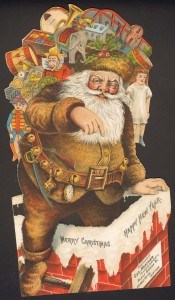





Then in 1931, Coca Cola put an ad in a newspaper with their own version of Santa Claus holding Red Coca Cola. Red is like the brand colour for Coca Cola.

Haha.... Now people are actually doing free advertisements for Coca Cola.
I know I have left lots of long forgotten-festivals that were celebrated during December. Why people were celebrating during these cold dark days, you ask. To end the dark days and hope for a new bright year.
This article gives you an introduction to the festivals that were celebrated during December and few origin stories of Christmas traditions like 'sharing gifts' taken from Saturnalia festival, 'bringing evergreen trees' to home taken from Norse tradition and 'Santa Claus' taken from Coca Cola ad.
I saved the best for Part-2. There I will write about the true origin of Christmas.
You won't believe it. It has a link to an ancient God who is not from Jerusalem but from India!
Stay Tuned!


Comments